Seiko
Founded 1881 · Tokyo, Japan · Kintarō Hattori
Seiko began in 1881 when Kintarō Hattori, aged 21, opened a watch and jewellery shop in Tokyo called K. Hattori. What started as repairs and retail became a manufacturer, and in time the house that put the world's first quartz watch on the market. Today it is a vertically integrated group making its own movements, spanning affordable watches (Seiko 5, Prospex) up to the high watchmaking of Grand Seiko, since spun off as its own brand.
History
In 1892 Hattori founded the Seikosha factory and began making his own wall and pocket clocks. In 1913 he presented the Laurel, the first wristwatch made in Japan. After the Great Kantō earthquake of 1923, production resumed and in 1924 the name "Seiko" appeared on a dial for the first time. In 1960 came the first Grand Seiko, the high-end line with its own chronometric standard. In 1965 came its first diver, the 62MAS. On 25 December 1969 it unveiled the Quartz Astron in Tokyo, the world's first quartz wristwatch, far more accurate than the mechanics of the day. In 1999 it developed Spring Drive, a mechanism pairing mechanical power with electronic regulation. In 2017 Grand Seiko became an independent brand to sharpen its identity worldwide.
Iconic models
Quartz Astron (1969)
The world's first quartz wristwatch; it changed the industry for good.
Seiko 5
The emblem of the affordable, dependable automatic — day-date and a crown at 4, mass-produced since 1963.
Prospex 'Turtle' (originally ref. 6309, reissued 2016)
An automatic diver whose cushion case earned it the turtle nickname; a tough, cheap classic.
SKX007
Seiko's reference automatic diver for decades; long considered the best value in watchmaking for what it delivers.
Alpinist
An adventure watch with an inner compass bezel, cathedral hands and its famous green dial with gilt markers.
Worth knowing
When the Quartz Astron went on sale in 1969 it cost roughly as much as a small car. Seiko chose not to keep the quartz technology to itself, which sped its adoption across the industry and set off the so-called quartz crisis that shook Swiss watchmaking.
Seiko at Reserva de Marcha
See all 43 in the catalogue →
5 Automatic Black Eastern Arabic Dial Men's Watch SNKP21J1

5 Sports Automatic Unisex Watch SRPJ83

5 Sports Men's Automatic Watch with Stainless Steel Case and Luminous Hands - Stylish Wrist Watches
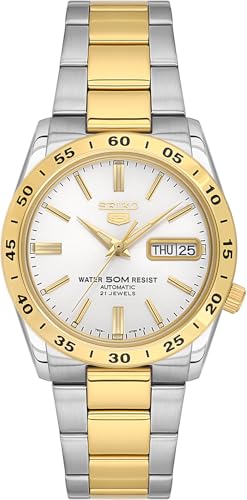
Automatic Watch SNKE04J1 Men's Made in Japan

Automatic Watch for Men - 5 Sports Collection - Men's Sport Watch, Stainless Steel, GMT Hand - Water-Resistant 100

Automatic Watch for Men - 5 Sports Collection - Men's Sport Watch, Stainless Steel, GMT Hand - Water-Resistant 100

Automatic Watch for Men - 5 Sports Collection - Men's Sport Watch, Stainless Steel, GMT Hand - Water-Resistant 100

Men's SRPL11 Prospex Watch