Opinel
Founded 1890 · Savoie, France · Joseph Opinel
Opinel is the French peasant's knife: a beechwood handle, a steel blade and a ring that locks it. Joseph Opinel created it in 1890 in the Alps of Savoie for the farmers of the area. Its design has not changed in any essential way in more than a century, and it is still made in the same valley.
History
Joseph Opinel was the son of a maker of farm tools. In 1890 he made the first series, numbered 1 to 12 by blade size — a system still in use: the no. 8 is the classic. In 1897 he registered the crowned hand as a trademark, taken from the coat of arms of Saint-Jean-de-Maurienne. The invention that made it safe came in 1955: the Virobloc, the rotating ring that locks the blade open — and, since 1990, closed as well. In 1985 the Victoria and Albert Museum in London included it among the hundred best-designed objects in history, alongside the Rolex watch and the Porsche 911. It remains a family company, now in its fourth generation.
Iconic models
No. 8
The usual one: an 8.5 cm blade, the size that fits a pocket and cuts bread, cheese and rope.
No. 12
The big one, at 12 cm; the one taken to the hills when a knife was a working tool.
Carbone vs. Inox
Two steels for the same body: carbon cuts better and rusts; stainless lasts longer and asks less care.
Outdoor series
A synthetic handle, a whistle and a shackle key; the modern version for the hills and the water.
Worth knowing
The Virobloc ring that locks it was invented in 1955, sixty-five years after the knife itself. Until then an Opinel would fold shut on you if you pushed the wrong way.
Opinel at Reserva de Marcha
See all 35 in the catalogue →
No. 08 Stainless Steel Folding Knife, Beechwood Handle + Leather Sheath

No. 08 Olivewood Folding Knife Set with Sheath, Wooden Box

No. 08 Carbon Steel Folding Pocket Knife, Beechwood Handle + Sheath

No. 06 Carbone, Carbon Steel Folding Pocket Knife, Beechwood Handle

No. 08 INOX, Stainless Steel Folding Pocket Knife, Beechwood Handle

No. 09 INOX, Stainless Steel Folding Pocket Knife, Beechwood Handle

No.08 Stainless Steel
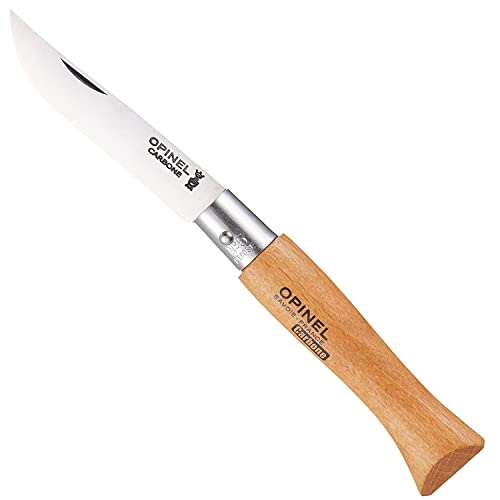
No. 02 Carbone, Carbon Steel Folding Pocket Knife, Beechwood Handle