Buck
Founded 1902 · Post Falls, Idaho, United States (it began in Washington State) · Hoyt Buck
Buck is the house that invented the modern folding knife as it is used today. Its founder was a blacksmith's apprentice who made every knife by hand from worn-out files, with a heat treatment of his own that left them harder than the competition's. Sixty years later a grandson brought out the model 110 and changed the whole category.
History
Hoyt Buck forged his first knife in 1902 out of old files, and developed a heat treatment that gave an edge and a toughness beyond what was normal at the time. After the Second World War his eldest son Al moved to San Diego and in 1945 the Bucks followed him: there they opened a workshop as H. H. Buck and Son. After his father's death, Al kept the bespoke knife business alive until incorporating Buck Knives, Inc. in 1961. In 1964 came the blow: the model 110 Folding Hunter, a folder with a back lock that held like a fixed blade and fitted on a belt. It changed the industry overnight and has sold more than fifteen million units. The company is still in family hands.
Iconic models
110 Folding Hunter (1964)
The folder that founded the category: back lock, clip-point blade and a leather sheath. More than fifteen million sold.
112 Ranger
The 110's little brother, the same design in pocket format; for many the house's best balance.
119 Special
The classic fixed hunting blade, with a black phenolic handle and an aluminium guard.
120 General
A large fixed blade for the hills, the serious tool in the catalogue.
0722 Spitfire
Anodised aluminium and a lockback: the light, modern reading of the 110.
Worth knowing
The first Buck knife was made from a worn-out file. What sold it was not the steel — that was scrap — but the temper: Hoyt Buck had hit on a heat treatment that held an edge far longer than the catalogue knives of his day.
Buck at Reserva de Marcha
See all 82 in the catalogue →
102BKS Woodsman 4"
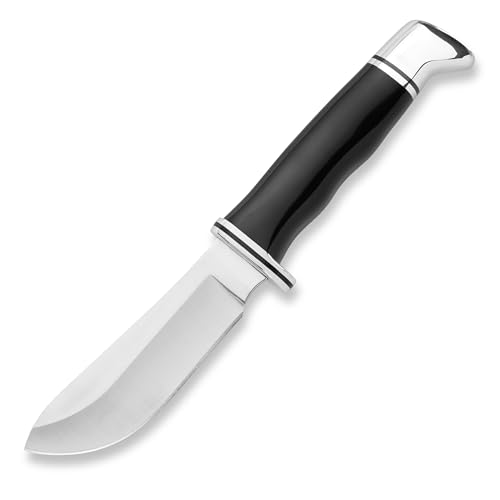
Knives 103 Skinner Fixed Blade Hunting Knife

Knives 112 Ranger Folding Knife with Finger Grooves and Leather Sheath

Knives 191 Buck Zipper Hunting Knife with Sheath, 6.3 oz

Knives 285 Bantam BLW EDC Pocket Knife, Black, 2.4 oz

Knives 692 Vanguard Hunting Knife with Sheath, Rubber Handle, 6.6 oz

Knives 327 Nobleman Folding EDC Pocket Knife, Titanium, 2.6 oz

Knives 373 Trio 3-Blade Folding Pocket Knife, Woodgrain, 1.9 oz